
Active or passive investment style?
Flash #3, October 24, 2024
The passive investment style implements the investment strategy selected by the investor on a rule-based or “passive” basis and adopts the composition of securities of the respective category benchmark within the investment categories. However, the active investment style attempts to create additional added value within the asset classes by means of active investment tactics (temporary overweighting and underweighting of asset classes) and active stock selection compared to the passive investment style.
Let us first recall the key finding from Economico Flash 2: the active management dimensions of investment tactics and stock selection have only a minor influence on the investment result compared to the choice of investment strategy anyway, which means that the question of investment style should not be overestimated. Except, of course, with regard to the resulting costs – because the active investment style causes substantially higher costs.
So which is more successful: the active or passive investment style? It depends on who you ask. The asset manager will tell you that the active investment style is preferable. However, as an investor you must be aware that the asset manager can simply earn more with an active investment style and is therefore not independent in his judgment. If, on the other hand, you consult independent sources, the track record of active asset management is poor.
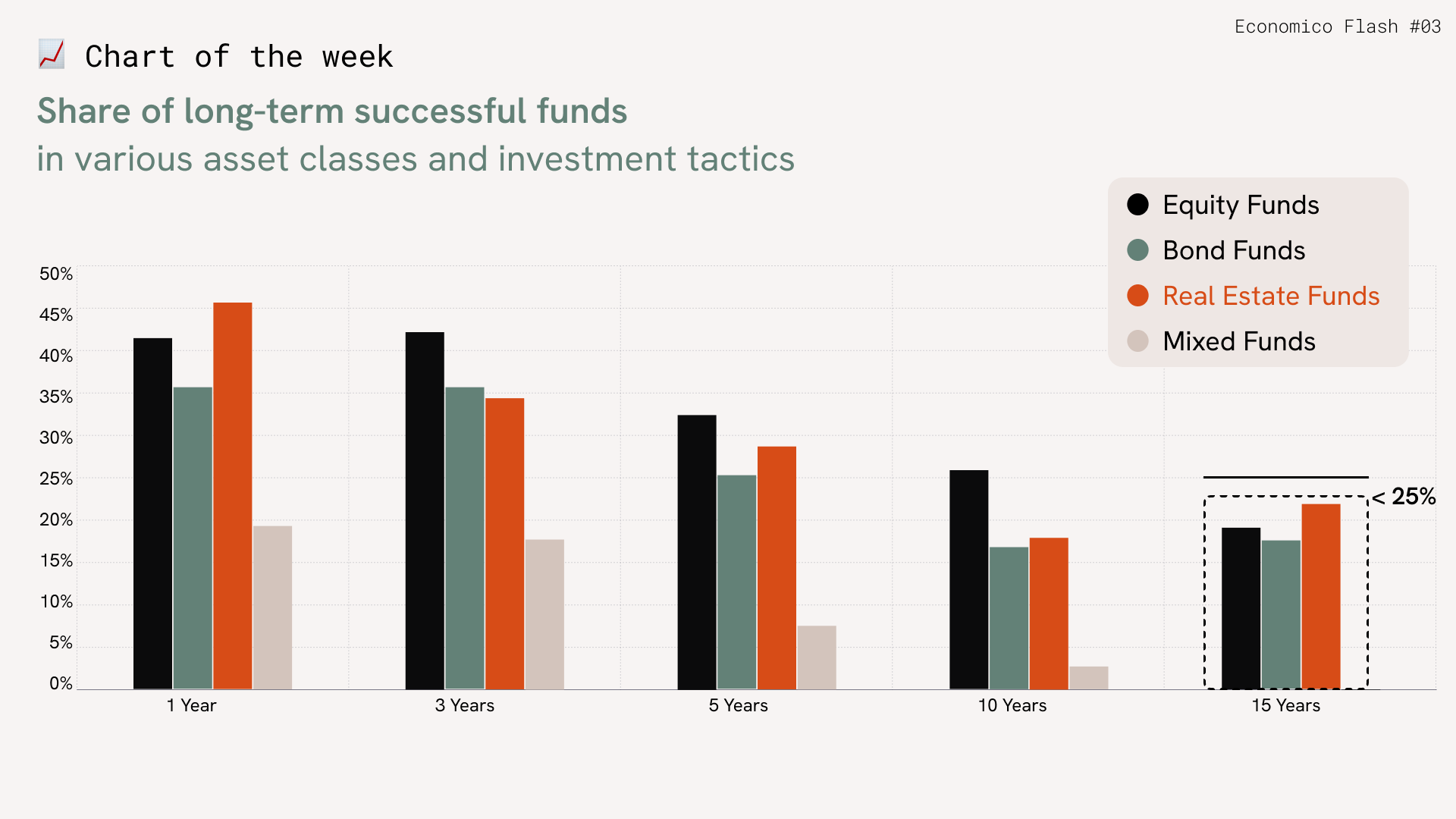
The Morningstar fund platform provides an impressive comparison. It examines what proportion of active funds in various asset classes can beat their benchmark. As a result, the proportion of successful funds in any asset class is below 25 percent after 15 years. The remaining 75 percent have performed worse than their benchmark or the fund has been liquidated in the meantime – which is not exactly a seal of quality for the fund.
Economico focuses on passive, cost-efficient asset management. The asset management mandates on offer use passive funds (either exchange-traded funds, or ETFs for short, or over-the-counter index funds) in the various asset classes. As investment style options, investors can choose between “passive according to market capitalization” or “passive taking ESG criteria into account”. Try it out.
Takeaways
- In the long term, only around 25 percent of active managers outperform their benchmark.
- The remaining 75 percent underperform the benchmark or close the fund.
- This speaks in favor of passive investment.
Takeaways
- In the long term, only around 25 percent of active managers outperform their benchmark.
- The remaining 75 percent underperform the benchmark or close the fund.
- This speaks in favor of passive investment.