
The Inflation Spectre in Retirement Planning
Flash #60, February 5, 2026
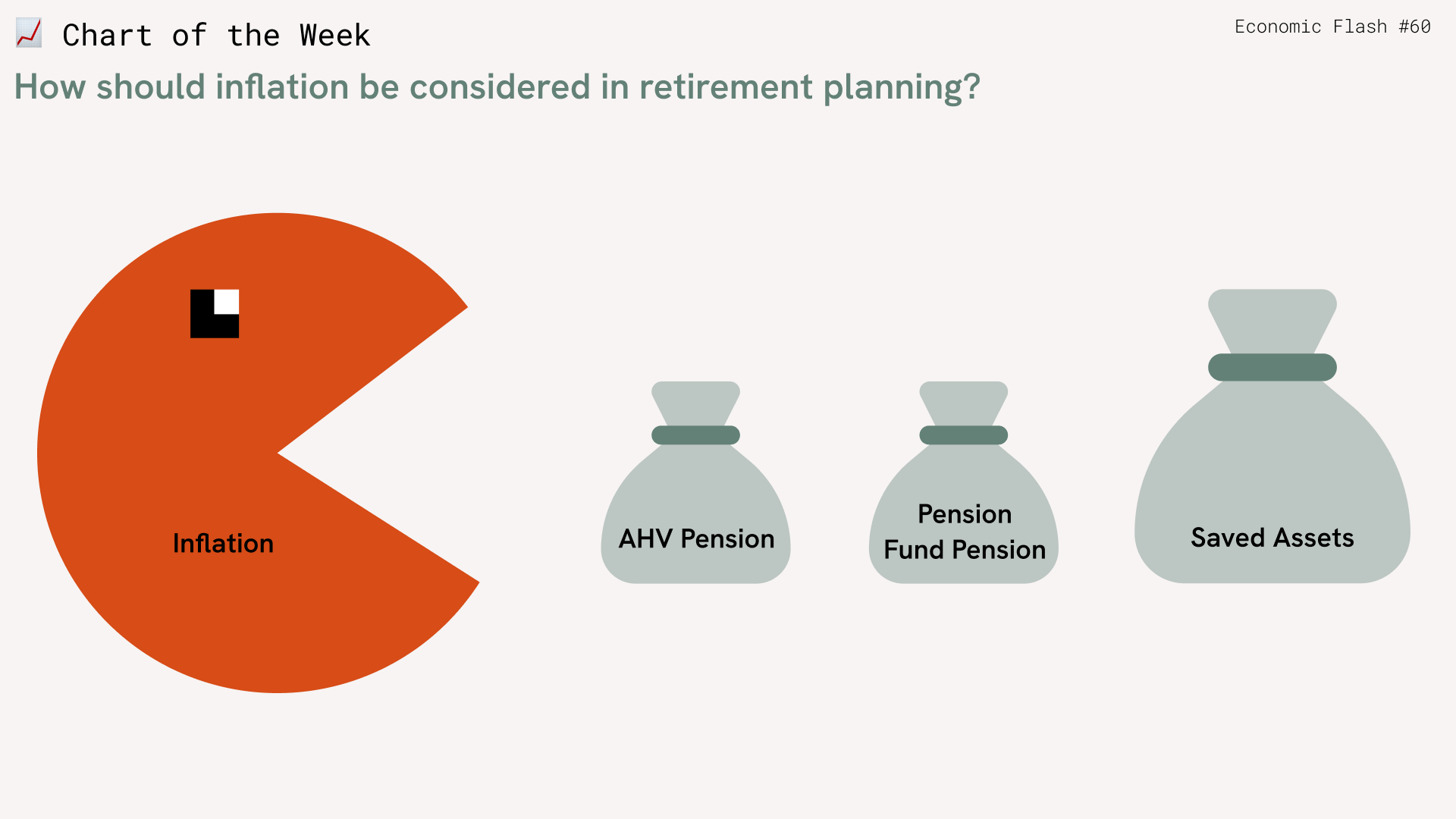
In financial and retirement planning, the way in which future inflation is taken into account is crucial. In many cases, the precautionary principle applies in this regard: future expenses are increased by an assumed inflation rate, while income and asset growth are not adjusted accordingly. However, this practice leads to economically inconsistent planning outcomes.
On one hand, AHV and IV pensions have a built-in inflation protection mechanism under Art. 33ter AHVG. When wages and prices rise, AHV pensions rise accordingly.
Pension fund (PK) pensions must also in principle be adjusted for inflation under Art. 36 BVG. The mandatory portion of the pension fund pension must be adjusted without exception, while the supplementary portion is adjusted provided the pension fund's financial situation allows for it. In recent years, many pension funds have also introduced rule-based participation models that allow retirees to benefit from positive developments as well.
When prices rise, interest rates generally rise too. Higher interest rates in turn lead to higher nominal investment returns and thus to a nominal increase in the value of assets. This phenomenon — whereby asset values also grow nominally when inflation rises — is referred to as "asset inflation."
A surge in inflation therefore means that not only expenses, but also income as well as asset and debt values adjust to the new price level. In the short term, these adjustments may occur at different speeds, but over the medium to long term, the effects largely balance out.
What does this mean for financial and retirement planning? When projecting various financial figures, inflation adjustments should either be applied consistently to all variables — or to none at all. The frequently used precautionary principle, whereby only expenses but not income and assets are adjusted for inflation, leads to distorted planning outcomes.
Since inflation forecasts are inherently imprecise and error-prone, it is in our view entirely sensible to dispense with inflation adjustments altogether in financial and retirement planning, and instead work with today's known nominal figures. This perspective is based on the plausible assumption that an inflationary surge affects all monetary variables in a similar way over the medium to long term.
Takeaways
- Inflation affects — sooner or later — all monetary variables in a similar way.
- With this certainty, one can dispense with the need for complex and error-prone inflation forecasts in retirement planning.
Takeaways
- Inflation affects — sooner or later — all monetary variables in a similar way.
- With this certainty, one can dispense with the need for complex and error-prone inflation forecasts in retirement planning.