
Currency Strategy and Currency Hedging: Follow-up
Flash #61, March 5, 2026
When investing in foreign currencies, you take on currency risk — whether intentionally or not. The return achieved on a foreign currency investment is always the sum of two components: firstly, the return achieved in local currency, and secondly, the exchange rate movement between the local currency and the home currency.
From the perspective of a CHF investor, we have just experienced another turbulent year with regard to the exchange rate component: the USD — which carries particular weight in foreign currency investments — depreciated by 12.65% against the CHF in 2025.
In principle, currency risk can be hedged, which is why calls for currency hedging among CHF investors grow louder again after years like this. However, hedging comes at a price from the perspective of a low-interest currency such as the CHF: with every hedging transaction, the interest rate differential between the domestic and the foreign currency is lost. Against the USD, this interest rate differential has been in the region of around 4% for some time.
There are certainly arguments in favour of currency hedging. On one hand, it reduces risk; on the other hand, proponents of the uncovered interest rate parity theory argue that the lost interest rate differential is offset over the long term by exchange rate movements. However, this remains a theoretical consideration.
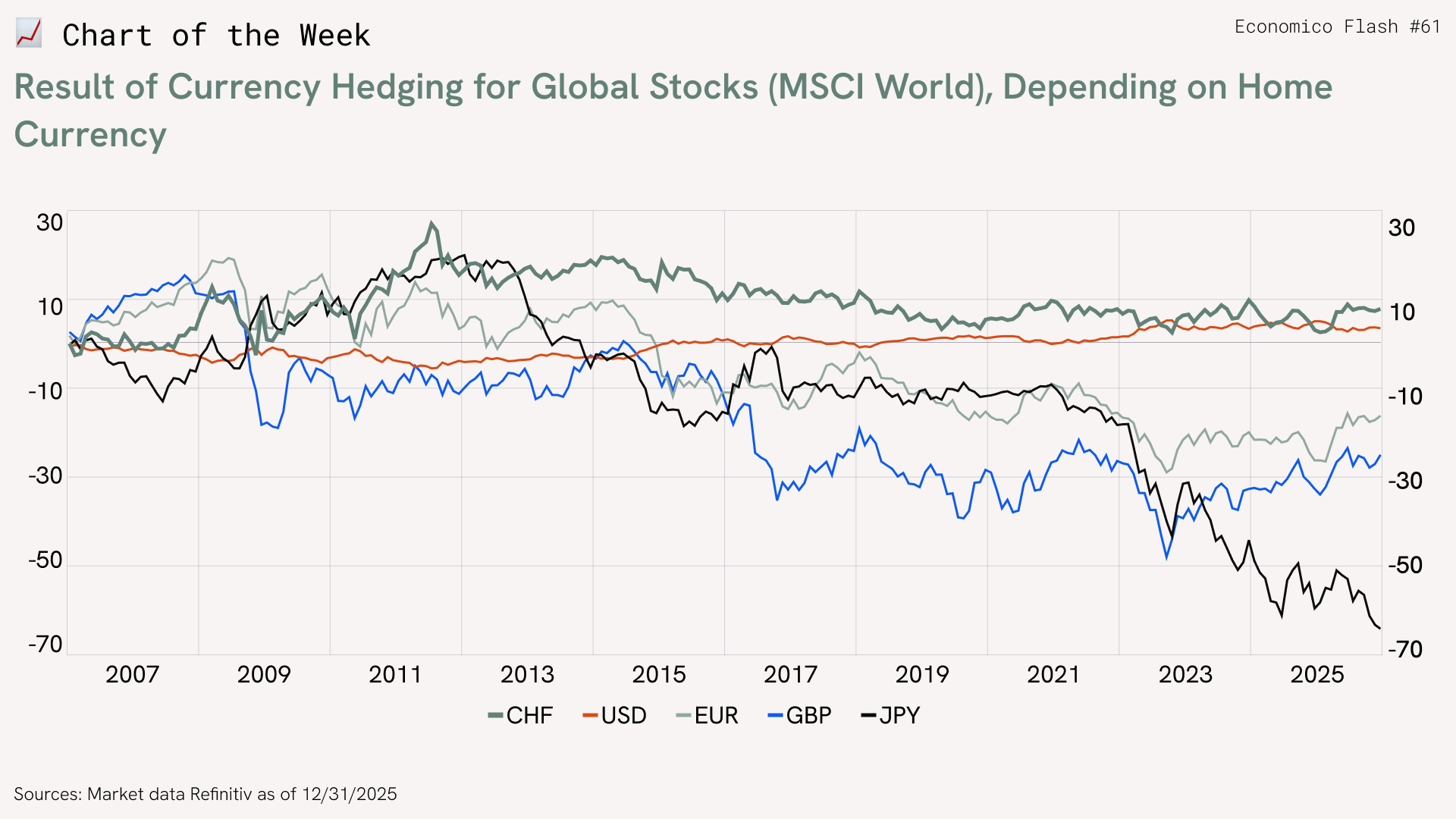
In the Chart of the Week, the hedging decision for a global equity portfolio (MSCI World) is analysed from the perspective of various home currencies — CHF, EUR, GBP, JPY, and USD — over the past 20 years. Each line shows the difference between a hedged and an unhedged portfolio.
According to the theory of uncovered interest rate parity, the result should be identical and all lines should run exactly along the zero axis. However, practice tells a different story: CHF and USD investors would have tended to benefit from currency hedging over the past 20 years. A CHF investor who invested CHF 100 in a global equity portfolio in 2005 would have ended 2025 with approximately CHF 8 more in assets with currency hedging than without.
For investors with home currencies such as EUR, GBP, or particularly JPY, hedging over the same period would, however, have been disadvantageous. These differences show that the theory of uncovered interest rate parity does not work reliably in practice, depending on the currency and the time period in question.
What does this mean for future hedging decisions? There is no clear right or wrong answer. For investors from a low-interest currency such as the CHF, the decisive factor is ultimately whether the foreign currency depreciates by more than the existing interest rate differential. Without a crystal ball, however, this question cannot be answered reliably.
Takeaways
- Currency hedging reduces risk.
- Currency hedging can either increase or reduce returns.
Takeaways
- Currency hedging reduces risk.
- Currency hedging can either increase or reduce returns.