
Legal Planning: The Living Will
Flash #64, May 21, 2026
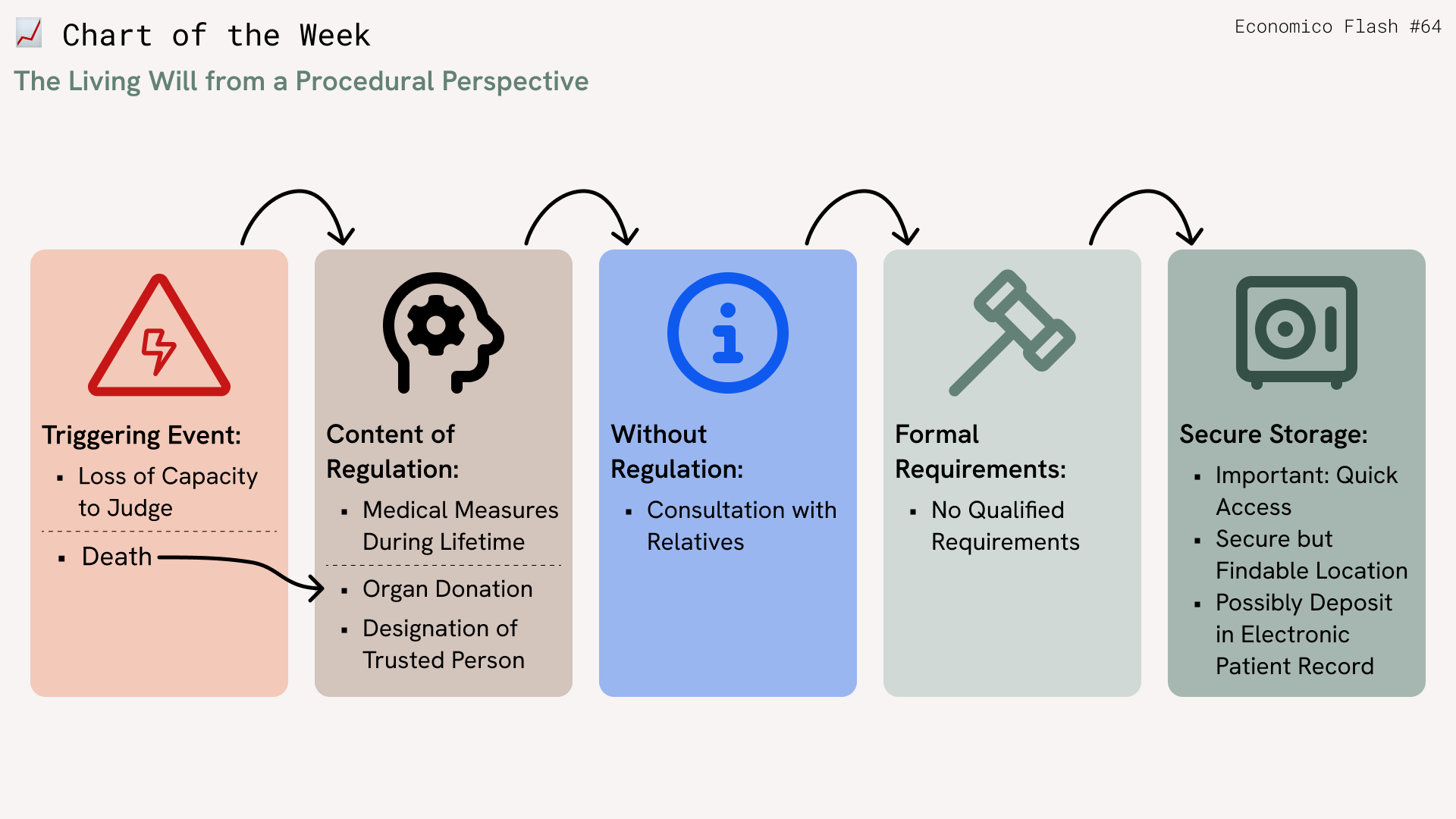
Triggering Event:
Generally, a living will takes effect upon the loss of mental capacity. However, a living will may also include instructions that take effect only upon death.
Contents of the Will:
In a living will, you specify which medical measures you wish to receive and which you refuse.
- Medical treatments during your lifetime: Consent to or refusal of life-prolonging treatments, intensive medical interventions, or palliative care.
- Medical provisions in the event of death: Specifically, provisions regarding organ donation.
- Representation: Appointing a trusted person to make medical decisions on your behalf if you are no longer able to do so.
What happens in the absence of a living will:
If there is no living will, medical decisions must be made on the person’s behalf. Typically, family members are consulted to try to determine the person’s presumed wishes. If these wishes are not clearly discernible or if there are differing opinions among those involved, the cantonal Child and Adult Protection Authority (KESB) steps in. For medical staff, the lack of clear instructions also poses a challenge, as decisions often have to be made under time pressure.
Formal requirements:
Unlike a lasting power of attorney, a living will is subject to less stringent formal requirements. It must generally be in writing, dated, and signed. Notarization is not required.
Storage:
The advance directive must be easily accessible in an emergency. Simply keeping it with your personal documents is often not enough. It is advisable to inform your relatives and the designated trusted person of its existence and where it is kept. If you have created an Electronic Patient Record (EPR), the advance directive can be stored in the EPR. Medical professionals can access the EPR in an emergency.
In cooperation with LegacyNotes, we are now offering a digital assistant on Economico to help you create an advance directive and set up emergency access. Shape the future according to your wishes!
Takeaways
- Advance medical directive while you are alive: You specify the medical treatments you wish to receive.
- Advance medical directive in the event of death: You decide on organ donation.
Takeaways
- Advance medical directive while you are alive: You specify the medical treatments you wish to receive.
- Advance medical directive in the event of death: You decide on organ donation.