
Legal Planning: The Will
Flash #65, May 28, 2026
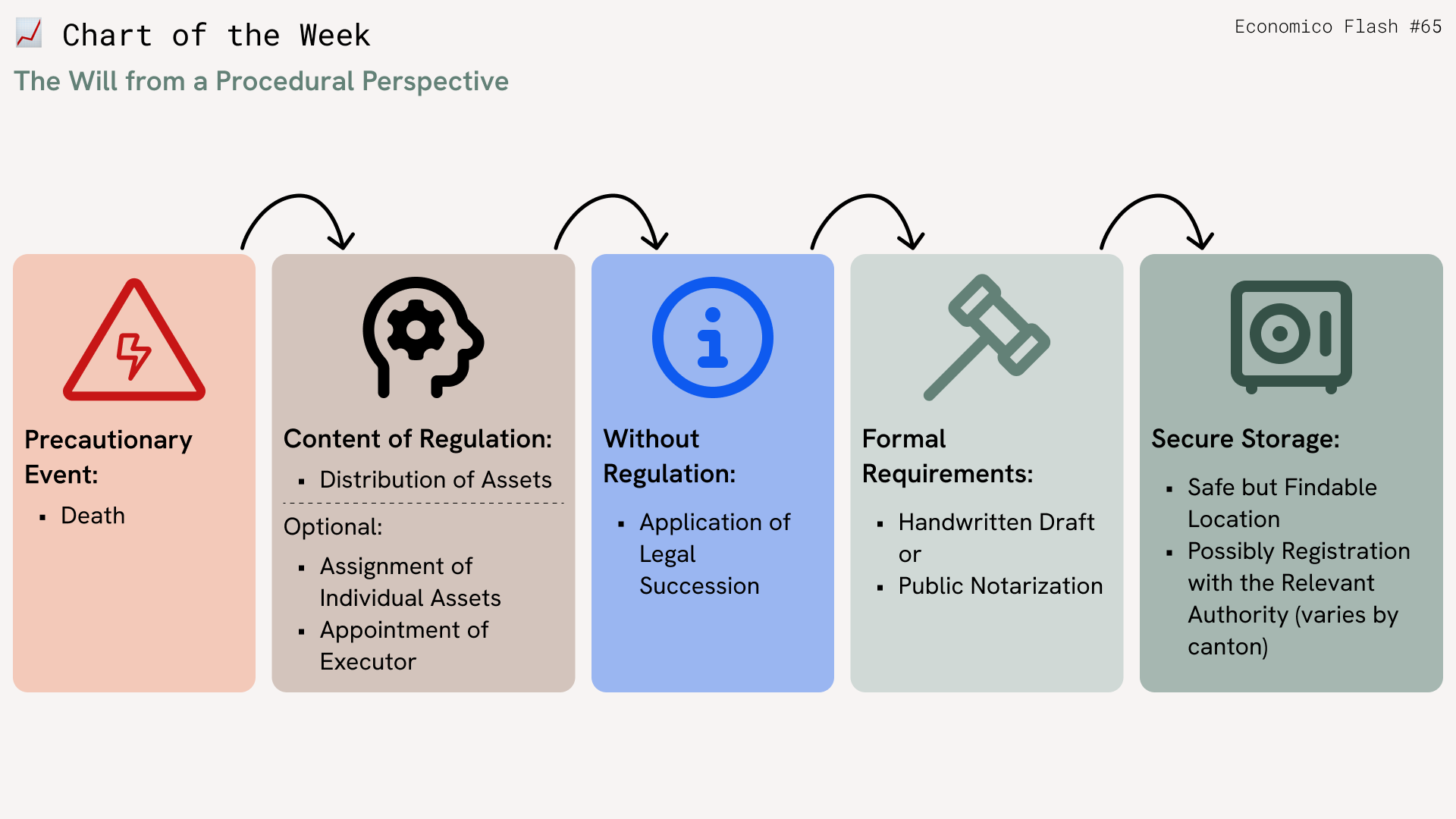
A will is a legal instrument under inheritance law used to determine the distribution of your assets after your death. But be aware: If you are married, marital property law takes precedence over inheritance law in the event of death, meaning your assets will first be distributed according to marital property law. In the absence of specific provisions, the community of accrued gains applies as the standard in Switzerland; any deviations from this are set forth in a prenuptial agreement between the spouses. If parents wish to arrange the distribution of their assets to their children regardless of the order in which the parents die, a contract of inheritance signed by both partners and, if applicable, the children is the more appropriate form than a will.
Triggering Event:
A will takes legal effect upon death.
Contents of the Provision:
- Distribution of Assets: In your will, you specify how you wish your assets to be distributed. However, you are bound by the statutory reserved share of at least 50% of the legal inheritance for your spouse, registered partner, and descendants (see Art. 470 et seq. of the Swiss Civil Code). Important: Funds paid out from the 2nd and 3rd pillars upon death cannot be governed by a will. More on this in the next Flash.
- Asset Allocations: Through so-called bequests, you can allocate specific assets to individual persons or organizations within the legal framework without naming them as heirs.
- Rights of Use and Conditions: Within the legal framework, you can assign rights of use to individual assets and impose conditions.
- Executor: You can appoint an executor.
What happens without a will:
Without a will, statutory succession under Art. 457–466 of the Swiss Civil Code (ZGB) automatically applies. The succession defined by law is referred to as intestate succession.
Formal Requirements:
For a will to be legally valid, there are clear formal requirements. It must either be entirely handwritten, dated, and signed, or it must be notarized.
Storage:
Of course, a will will only have the intended effect if it can actually be found when the time comes. The document should be stored in a secure but accessible location, such as with your personal documents or with a trusted person. The safest option is to deposit it with the relevant authority—which specific authority this is must be clarified at the cantonal level.
In cooperation with LegacyNotes, we are now offering a digital assistant on Economico to help you draft a will. Shape the future according to your wishes!
Takeaways
- Matrimonial property law takes precedence over inheritance law
- One person distributes: will; two people distribute (jointly): inheritance contract
Takeaways
- Matrimonial property law takes precedence over inheritance law
- One person distributes: will; two people distribute (jointly): inheritance contract