Pension vs. Lump-Sum Decision in Dual-Income Households
Flash #68, September 3, 2026
When retirement approaches in dual-income households, a familiar pattern often comes up once the pension-versus-lump-sum decision needs to be made: he — who typically retires earlier and with more retirement capital — takes the pension; she then takes the lump sum, and together the couple treats themselves to something nice. Is this really the wisest choice?
First, the economic value of the two pension fund pensions can differ — a difference that can be quantified via the interest rate guarantee discussed in Flash 5. The PensionCompass, the portal of the Swiss pension fund association, lets you approximate the size of this interest rate guarantee. Economically relevant differences in the interest rate guarantee arise mainly in the case of:
- differing conversion rates
- a large age gap between the two people
- differing levels of survivor's pension entitlement (typically 60%, though this can be higher or lower depending on the pension fund), and/or
- large differences in life expectancy
If the interest rate guarantee for Person A is (significantly) higher than for Person B, then Person A should choose a higher pension share and Person B a higher lump-sum share.
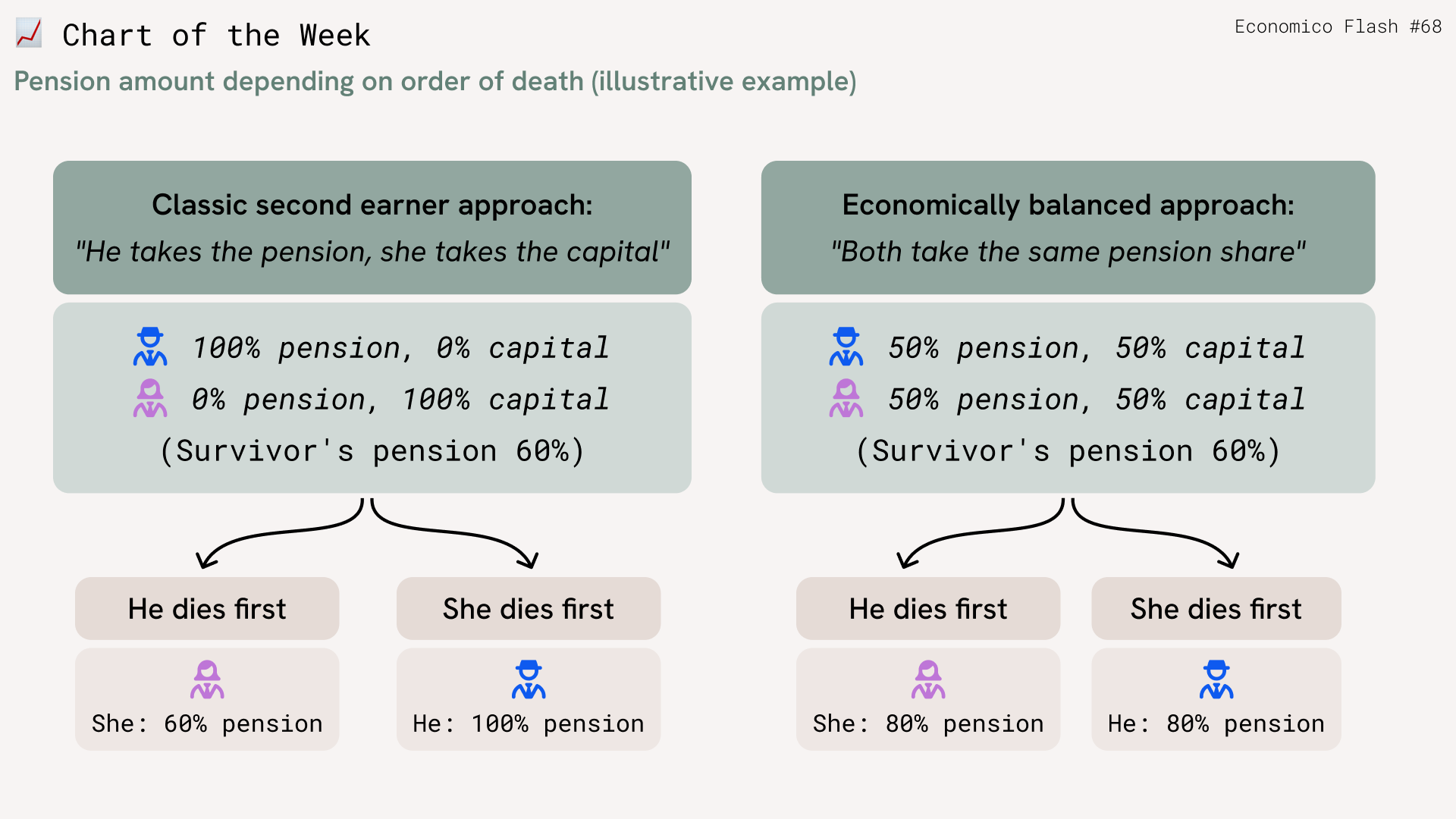
If the interest rate guarantee — or the economic value of the two pension fund pensions— does not differ significantly, the goal must be to secure as continuous an income stream as possible for both people, regardless of the order in which they die. This is illustrated in the Chart of the Week: with 100/0 solutions, the person who takes the lump sum and outlives their partner is at a disadvantage, since they then receive only the reduced survivor's pension from their partner's pension fund.
With balanced withdrawal solutions, on the other hand, the order of death makes no difference. Here, "balanced" refers to the absolute pension amounts, not the percentage withdrawal ratios. An example: at age 65, he has retirement capital of CHF 600,000 and she has CHF 400,000, both with a conversion rate of 5%. That gives him a 100% PK pension of CHF 30,000 per year, and her CHF 20,000. To ensure that both partners end up with the same pension income after the other's death, she must draw a higher percentage pension share than he does.
Also worth considering:
- The death of one partner also affects the amount of the individual AHV (old-age and survivors') pension paid out afterward. Individually calculated AHV pensions can differ. The person with the lower individual AHV pension entitlement should tend to draw a higher PK pension.
- If the life expectancy of the two people differs (significantly), the person with the higher life expectancy should draw a higher pension share.
Takeaways
- Consideration 1: Which pension fund pension is worth more — i.e., which achieves the higher interest rate guarantee?
- Consideration 2: How can pension income be structured to be as balanced as possible, regardless of the order of death?
Takeaways
- Consideration 1: Which pension fund pension is worth more — i.e., which achieves the higher interest rate guarantee?
- Consideration 2: How can pension income be structured to be as balanced as possible, regardless of the order of death?